DSA Interview Questions: What Really Gets Asked (and How to Prepare Smart)
Most companies repeatedly hit the same set of core topics: arrays, strings, hash tables, linked lists, stacks and queues, trees, graphs, sorting, searching, and dynamic programming. The good news is that this makes the interview space highly predictable—if you prepare methodically.
This article breaks down:
- The main types of DSA interview questions
- The core topics and patterns you must master
- How interviewer expectations change by company and seniority
- A practical study roadmap
- How to use a question-tracking workflow (e.g., DSAPrep + LeetCode) to avoid random grinding and actually improve
1. Types of DSA Interview Questions You'll See
Not all DSA questions are the same. Most interviews mix the following categories.
1.1 Conceptual / Theory Questions
These test whether your fundamentals are solid. Examples:
- What is a hash table? When would you prefer it over a balanced BST?
- What is the time and space complexity of merge sort vs quicksort and why?
- What is the difference between a stack and a queue? Real-world use cases?
Conceptual questions are often quick, but they reveal whether you have the mental model needed for deeper problem-solving.
How to prepare
Be able to define each core structure (array, linked list, stack, queue, hash map, tree, heap, graph). Know time complexities for basic operations: insert, delete, search, traversal. Be ready with 1–2 practical use cases for each.
1.2 Implementation-from-Scratch Questions
These test whether you can implement basic data structures or algorithms without relying on language libraries:
- Implement a stack using two queues
- Implement an LRU cache from scratch
- Implement a binary search tree with insert, search, and delete
These questions reveal how deeply you understand invariants and operations.
How to prepare
Implement: singly and doubly linked lists, stack and queue (using arrays and linked lists), binary search tree (including deletion), and heap (min and/or max). Implement at least two classic sorting algorithms (e.g., merge sort, quicksort) and be able to explain them step by step.
1.3 Problem-Solving / Coding Questions
This is where most of your time will go. Typical examples:
- Given an array of integers, return indices of the two numbers such that they add up to a specific target (classic Two Sum)
- Merge overlapping intervals
- Find the length of the longest substring without repeating characters
- Number of islands in a grid (graph traversal)
- Longest increasing subsequence (dynamic programming)
These often map to well-known patterns (more on that later). Your job is to recognize the pattern, adapt it, and write correct, efficient code.
1.4 Complexity & Optimization Questions
Even if you get a working solution, interviewers will ask:
- What is the time and space complexity of your solution?
- Can you do better?
- Why did you choose a hash map instead of sorting first?
Strong candidates not only code but also justify trade-offs and reason about alternative designs.
1.5 Edge Cases & Follow-Ups
Follow-ups are where interviews are really decided:
- How does your solution behave with an empty array, huge input size, repeated values, negative values?
- Can you do it in-place?
- How would your approach change if the array is streamed or infinite?
Practicing follow-ups builds the habit of thinking beyond "happy path" coding.
2. Core DSA Topics You Must Master
There is a near-consensus across guides and curated lists: certain topics appear in interviews again and again. Instead of chasing hundreds of random problems, focus on these pillars.
2.1 Arrays and Strings
These are the highest-ROI topics. A huge percentage of interview problems can be mapped back to arrays and strings with pattern-based solutions.
Typical questions:
- Two Sum and its variants (k-sum, three-sum, four-sum)
- Maximum subarray (Kadane's algorithm)
- Move zeroes, sort colors
- Longest substring without repeating characters (sliding window)
- Group anagrams, valid anagram (hashing)
Key patterns:
- Two pointers (for sorted arrays, partitioning, and pair problems)
- Sliding window (for substrings/subarrays with some property)
- Prefix sums and hash maps for fast aggregation and frequency counting
2.2 Hashing (Hash Maps and Sets)
Hash tables power many "linear-time with memory" solutions:
- Detect cycles in arrays or linked lists by storing seen states
- Check if two arrays are permutations of each other
- Subarray sum equal to k using prefix sum + hash map
Know how hash tables work internally (hash function, collision handling) and their average vs worst-case complexities.
2.3 Linked Lists
Product-based companies often love linked list questions, and some (like Amazon) are known to repeatedly ask around lists and trees.
Common questions:
- Reverse a linked list (iterative and recursive)
- Detect a cycle in a linked list (Floyd's cycle detection)
- Merge two sorted linked lists
- Remove nth node from end of list
- Find intersection point of two linked lists
Key patterns:
- Fast and slow pointers (to detect cycles, find middle, etc.)
- Careful pointer manipulation and null checks
2.4 Stacks and Queues
These appear both directly and as helper structures for algorithms.
Typical questions:
- Valid parentheses, minimum add/remove to make parentheses valid
- Evaluate Reverse Polish Notation
- Implement queue using two stacks or stack using two queues
- Next greater element using a stack (monotonic stack)
Also understand BFS on trees/graphs (queue) and DFS iterative implementations (stack).
2.5 Trees (Binary Trees, BSTs, Tries)
Trees are essential for mid–senior roles and top companies.
Common questions:
- Traversals (inorder, preorder, postorder, level-order)
- Maximum depth of binary tree
- Validate binary search tree
- Lowest common ancestor
- Serialize and deserialize a binary tree
- Implement Trie (prefix tree)
Key concepts:
- Recursion for tree traversal
- Differences between binary trees, BSTs, and heaps
- Impact of balance on time complexity
2.6 Graphs
Graph questions are frequent for more advanced roles or system-heavy companies.
Core patterns:
- BFS and DFS on adjacency list/matrix
- Topological sort (Kahn's algorithm or DFS)
- Detect cycles in directed/undirected graphs
- Connected components, number of islands, flood fill
- Shortest path basics (BFS on unweighted graphs)
Even if you do not go very deep into advanced graph algorithms, solid BFS/DFS intuition is crucial.
2.7 Recursion and Backtracking
Many combinatorial problems are fundamentally about exploring search space:
- Generate permutations, combinations, subsets
- N-Queens
- Sudoku solver
- Word search on a matrix
Backtracking is about choice → explore → undo choice. Being able to write clean recursive code and reason about complexity here is a big plus.
2.8 Dynamic Programming (DP)
DP is often seen as a "filter" for strong candidates. Not every company will ask deep DP questions, but top-tier ones often do.
Classic DP families:
- Knapsack variants
- Longest common subsequence / substring
- Coin change (min coins / number of ways)
- Fibonacci-style problems
- Grid paths with obstacles
Concepts:
- Overlapping subproblems
- Optimal substructure
- Top-down (memoization) vs bottom-up (tabulation)
2.9 Sorting and Searching
Even if you rarely implement them manually at work, interviewers expect you to:
- Know comparison-based sorting algorithms and their complexities
- Understand binary search deeply—not just for "find target in sorted array" but also "find first/last occurrence," "find boundary," and "binary search on answer space"
3. Patterns: The Shortcut to Mastering DSA Questions
One of the most effective modern approaches is to study LeetCode-style patterns rather than isolated problems. Experts have shown that mastering around 7–15 core patterns (two pointers, sliding window, DFS/BFS, binary search, dynamic programming, etc.) covers a large majority of real interview questions.
Two Pointers
Pair-sum problems, reverse array/string, removing duplicates in-place
Sliding Window
Longest/shortest substring or subarray satisfying a condition
DFS/BFS
Trees, graphs, grid traversal, connected components
Binary Search
On sorted arrays, rotated arrays, and on "answer space"
Backtracking
Permutations, combinations, subsets, partitioning
Greedy + Intervals
Merge intervals, meeting rooms, jump game variants
Dynamic Programming
Subsequence, knapsack, partition, edit distance
Instead of solving 500+ random problems, focus on:
- Learning each pattern's template
- Solving a small curated set of problems that exemplify that pattern
- Revisiting the hardest ones periodically until they feel natural
4. Company-Wise DSA Questions: Why They Matter
While core topics are broadly similar, many companies exhibit topic preferences:
- Some repeatedly ask arrays + strings + hash maps
- Others love trees and graphs
- Amazon, for example, is often associated with linked list and tree-heavy questions
- Public resources already list must-do questions company-wise (Google, Amazon, Microsoft, etc.)
Company-wise lists are available on sites like GeeksforGeeks and others; they show historically asked questions, with tags for difficulty and topic.
How to use company-wise data effectively
- Pick your target companies (e.g., Amazon, Google, Microsoft)
- Look at company-wise sets to see which topics and patterns repeat
- Use that to tilt your practice: If Amazon repeatedly asks trees and linked lists, ensure you are doing extra problems in those areas. If Google repeats graph + DP patterns, allocate more time there.
Where DSAPrep.dev fits in
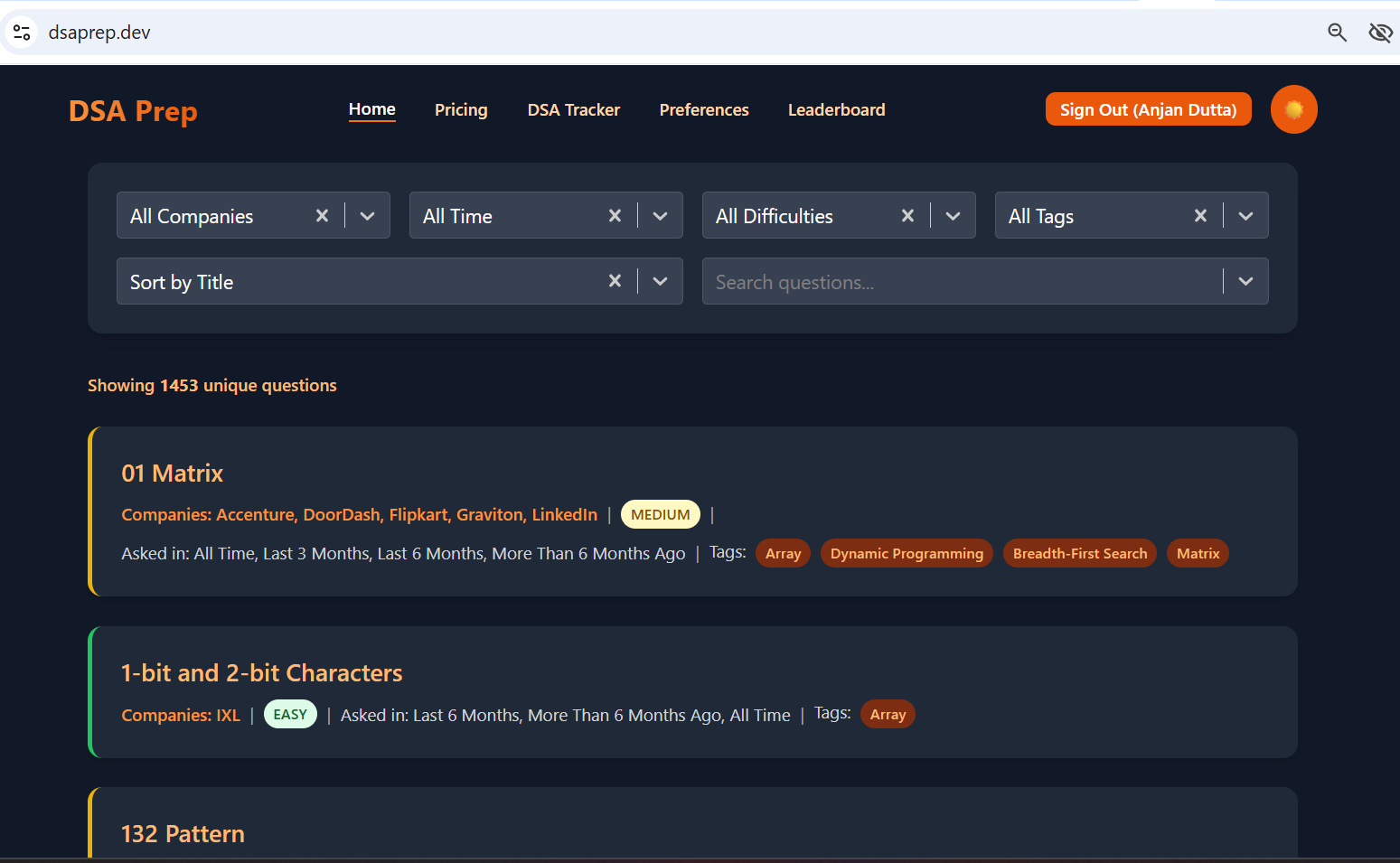
Instead of juggling spreadsheets or manual notes, a tool can centralize this workflow. DSAPrep.dev lets you:
- Search and filter problems company-wise (e.g., "Amazon + Tree + Medium")
- See your progress on those sets and avoid solving the same questions blindly again
- Combine company-specific practice with pattern-based tags to ensure you are covering both angles
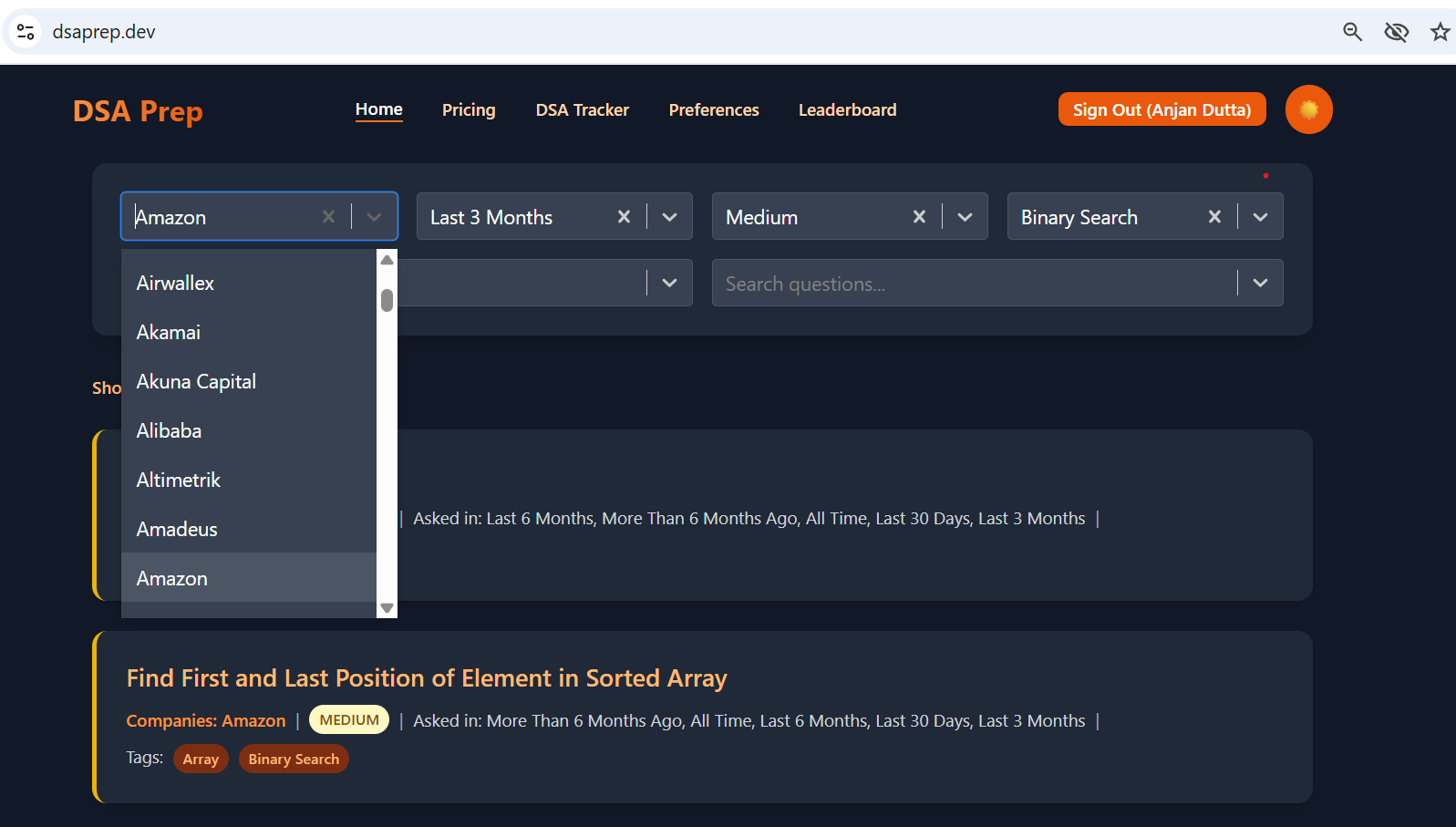
Used well, company-wise data is not about memorizing leaked questions; it is about aligning your prep with what is statistically likely to appear.
5. How to Answer DSA Questions in an Interview
Solving the problem is half the story. The other half is how you communicate during the interview.
5.1 Clarify the Problem
Before rushing to code:
- Restate the problem in your own words
- Clarify constraints: input size, ranges, duplicates, sorted/unsorted
- Ask about edge cases: empty input, nulls, negative numbers, large values
This shows structured thinking and often helps the interviewer correct misunderstandings early.
5.2 Think Aloud and Start with a Simple Solution
Interviews reward transparent reasoning:
- Start with a straightforward (even if not optimal) solution
- Analyze its complexity openly
- Then propose optimizations and patterns
"A brute-force approach would be O(n²) by checking all pairs, but we can do better using a hash map to get average O(n) time."
This makes the conversation collaborative and gives your interviewer hooks to guide you.
5.3 Choose the Right Data Structures
Relate your choice back to the properties you need:
- Hash map for O(1) average lookup
- Heap for top-k or min/max in a stream
- Trie for prefix lookups
- Queue for BFS; stack for DFS or parsing
Interviewers are looking for alignment between requirements and structure.
5.4 Write Clean, Structured Code
- Use meaningful variable names
- Keep functions small and focused
- Handle edge cases explicitly (empty inputs, single elements)
- Avoid unnecessary complexity or premature micro-optimizations
Even under time pressure, structure matters.
5.5 Analyze Complexity and Trade-offs
After coding:
- State time and space complexity
- Briefly mention alternatives: "We could also sort first and use two pointers; that would be O(n log n) time but O(1) extra space."
- If you made a trade-off (e.g., using extra memory to gain speed), say so
This demonstrates a systems mindset rather than just problem solving.
6. A Practical 6–8 Week Roadmap for DSA Interview Prep
Multiple guides recommend a phased approach: start with high-frequency topics, then add depth and patterns, with regular mock interviews.
Here is a template you can adapt:
Weeks 1–2: Fundamentals – Arrays, Strings, Hashing
- Learn/refresh: Arrays and strings basics, two pointers, sliding window, hash maps and sets
- Focus on easy → medium problems
- Add 1–2 stack/queue problems per day
Goal: You should be comfortable recognizing and implementing two-pointer and sliding-window patterns for common array/string problems.
Weeks 3–4: Linked Lists, Stacks/Queues, Trees
- Implement: Singly and doubly linked lists, stack and queue (array + linked list), binary trees and BSTs
- Practice: Reversals, merging lists, detecting cycles, tree traversals and classic tree problems (depth, symmetry, LCA)
Goal: Linked list and tree questions feel approachable, not scary. You can write recursive tree code quickly and correctly.
Week 5: Graphs and Backtracking
- Graph basics: BFS and DFS on adjacency list, number of islands, course schedule, connected components
- Backtracking: Subsets, permutations, combinations, simple grid backtracking
Goal: Comfort with transforming problem statements into a graph or search space and traversing it systematically.
Week 6: Dynamic Programming and Advanced Patterns
- Study common DP templates: 1D DP (Fibonacci, climb stairs, house robber), 2D DP (LCS, edit distance-like problems), knapsack-style problems
- Revisit tricky problems from previous weeks and solve them again faster
Goal: DP is no longer a black box. You can identify overlapping subproblems and derive a recurrence.
Weeks 7–8: Company-Wise & Mock Interviews
- Use company-wise lists for your target companies
- Do timed sessions (e.g., two 45–60-minute problems back-to-back)
- Focus on: Weak topics discovered so far, behavior during constraints (clarifying, thinking aloud, testing)
- If interviews are very near, shift towards revision and consolidation rather than learning brand-new topics
7. Tracking Progress and Revision (Instead of Random Grinding)
A common trap: solving 200+ problems but forgetting most of them a month later. Interview prep is long-term learning, not just short-term streaks.
To retain patterns and problem structures:
- Tag and classify each problem you solve: Topic(s) (Arrays, Hashing, Graphs), Pattern(s) (Sliding window, Two pointers, DP), Difficulty (Easy/Medium/Hard), Company tags, if known (Amazon, Google, etc.)
- Mark: "Solved with hints", "Could not solve", "Solved but not confident"
- Build a revision queue: Revisit hard/failed problems after a few days. Revisit them again after a few weeks until they feel automatic.
How DSAPrep.dev can help structure this
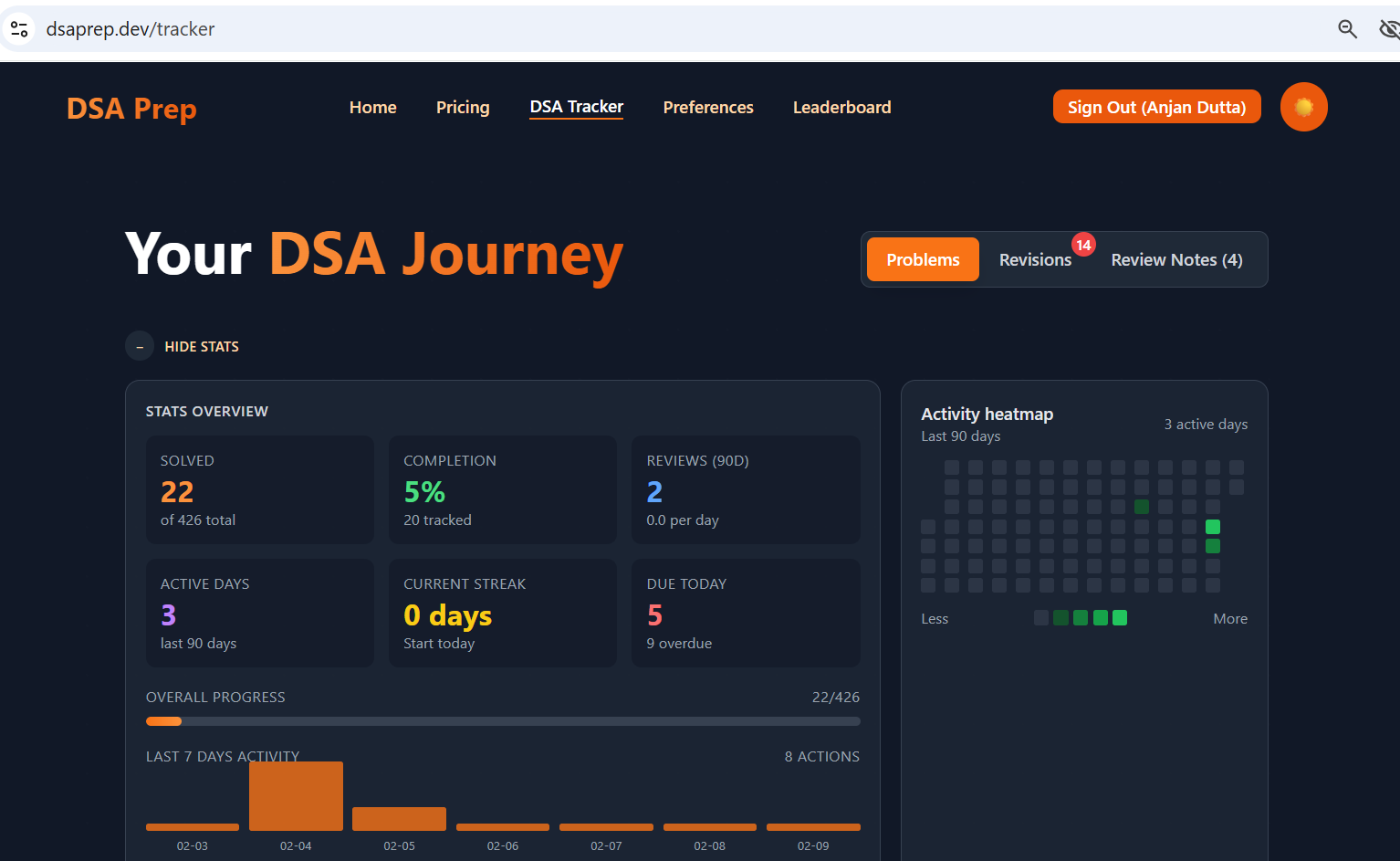
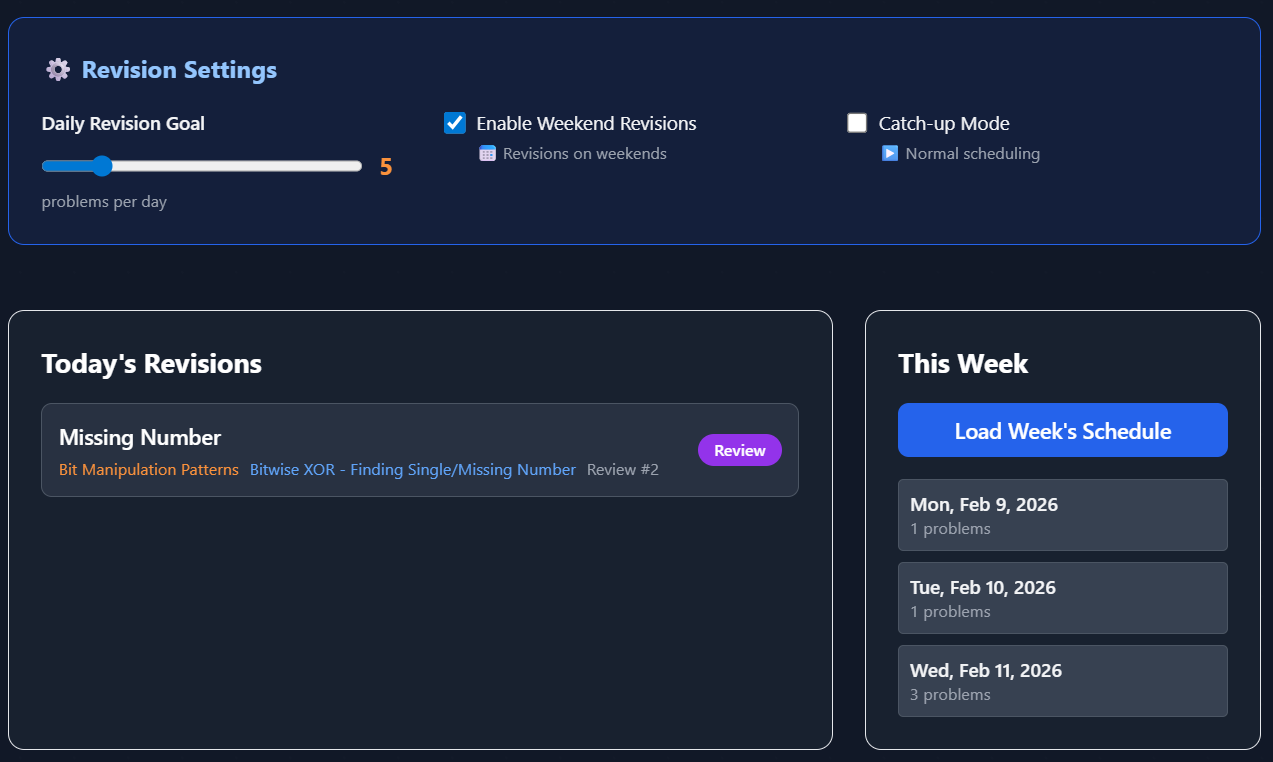
Since LeetCode itself doesn't give a strong "spaced repetition" workflow, an external tracker can fill the gap. DSAPrep.dev is designed exactly around:
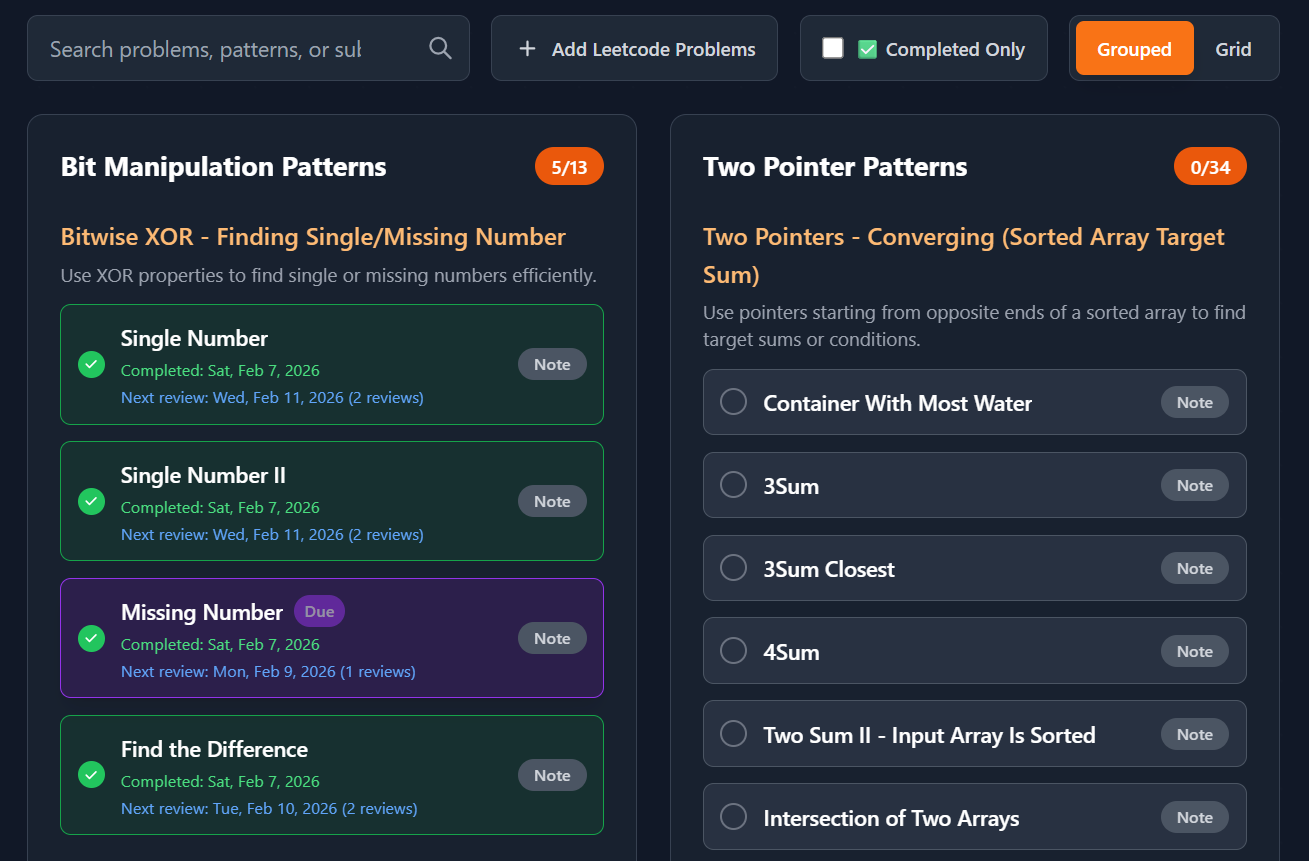
- Tracking your LeetCode progress across topics and companies
- Providing a spaced-repetition-style revision pipeline, so hard problems resurface just when you are about to forget them
- Letting you see coverage across patterns and companies instead of mindlessly chasing problem counts
This style of prep prevents you from:
- Re-solving only your comfort-zone problems
- Forgetting patterns you worked hard to learn
- Neglecting certain companies or topics unintentionally
The goal is measured, deliberate practice, not raw grind.
8. A High-Yield Checklist of DSA Question Themes
Instead of listing 100 specific questions, here is a compact checklist of themes and canonical examples to ensure you are hitting what most company sets and curated lists emphasize.
For each theme, you should know at least a couple of representative problems:
Arrays and Strings
- Two Sum and variations (k-sum)
- Maximum subarray (Kadane)
- Merge intervals, insert interval
- Longest substring without repeating characters
- Longest palindrome substring
- Product of array except self
Hashing & Prefix Sums
- Subarray sum equals k
- Longest consecutive sequence
- Group anagrams
- Top k frequent elements
Linked Lists
- Reverse list (iterative and recursive)
- Detect cycle (Floyd)
- Merge two sorted lists
- Remove nth node from end
- Partition list around a value
Stacks and Queues / Monotonic Structures
- Valid parentheses
- Min stack
- Next greater element
- Largest rectangle in histogram
- Sliding window maximum
Trees
- Maximum depth
- Symmetric tree
- Binary tree level order traversal
- Validate BST
- Lowest common ancestor
- Serialize and deserialize binary tree
- Kth smallest element in BST
Graphs
- Number of islands
- Clone graph
- Course schedule (topological sort)
- BFS shortest path in unweighted grid/graph
- Detect cycle in directed/undirected graph
Backtracking
- Subsets
- Permutations
- Combination sum variants
- N-Queens
- Word search
Dynamic Programming
- Climbing stairs / house robber
- Coin change (min coins / number of ways)
- Longest increasing subsequence
- Longest common subsequence
- Edit distance
- Partition equal subset sum
Misc / Advanced
- Heap-based problems (kth largest, top-k elements)
- Union-Find (disjoint set) basics
- Tries for word dictionaries
- Segment trees or Fenwick trees (for very advanced prep)
You can mirror this checklist as tags or filters in your practice tool.
9. Common Mistakes and How to Avoid Them
Mistake 1: Random LeetCode Grinding
Solving random problems every day feels productive but leads to uneven coverage and poor retention.
Fix: Follow a roadmap (like the 6–8 week plan above) and systematically track patterns and topics covered.
Mistake 2: Ignoring Easy Problems
Easy problems often cover core techniques and edge cases. Skipping them can leave gaps in understanding.
Fix: Use easy problems to warm up, test new patterns, and build confidence before moving to mediums and hards.
Mistake 3: Not Revising Old Problems
Without revision, patterns fade quickly and questions feel "new" again during interviews.
Fix: Use a structured revision queue, preferably spaced repetition–style, to resurface old problems at increasing intervals.
Mistake 4: Focusing Only on Code, Not Communication
Some candidates can eventually get to a solution but communicate poorly—no clarifications, no high-level plan, no complexity discussion.
Fix: Practice mock interviews, even if only by talking aloud while solving. Deliberately include: restating the problem, discussing brute force vs optimal, explaining complexity and trade-offs.
Mistake 5: Ignoring Company-Specific Trends
If your dream company repeatedly asks certain categories but you are underprepared in them, you are handicapping yourself.
Fix: Use company-wise lists and tools (like DSAPrep's company filters) to align a portion of your practice specifically to those companies' historical patterns.
10. Bringing It All Together
DSA interview questions may look intimidating at first glance, but they are highly structured and repetitive across companies. By focusing on:
- The core topics (arrays, strings, hashing, linked lists, trees, graphs, DP, etc.)
- A small set of high-yield patterns
- Company-wise trends for your target roles
- A tracked, revisable practice workflow
you dramatically increase your chances of performing well when it matters.
If you already solve problems on LeetCode or similar platforms, the missing layer is usually:
- A single view of your progress by topic, difficulty, and company
- A revision system that resurfaces important problems before you forget them
That is exactly the layer a tool like DSAPrep.dev is built to provide—without replacing your primary problem sources, but organizing and amplifying them.
Use this article as a checklist and reference. If you steadily work through the core topics, patterns, and company-wise sets—while tracking and revising your progress—you will find that most "new" DSA interview questions start to feel familiar long before the actual interview.